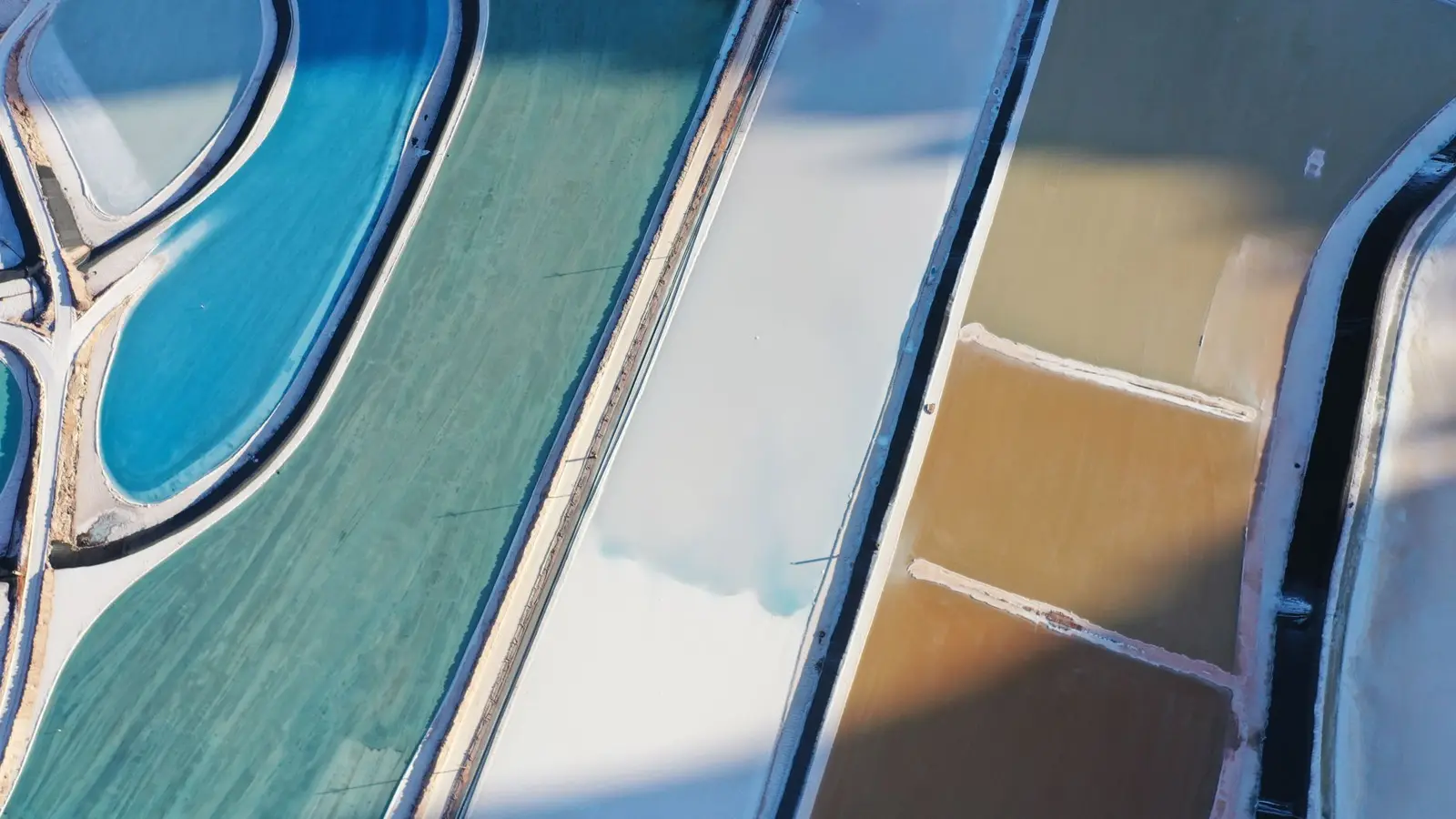
Direct lithium extraction versus solar ponds
Evaporation ponds concentrate lithium over 12–24 months and recover roughly 40–60% of it. Direct lithium extraction (DLE) selectively pulls lithium from brine in hours using adsorbents, ion-exchange resins, solvent extraction or electrochemical cells, with recoveries of 70–90%+ and the spent brine returned to the reservoir. DLE does not remove the water problem; it moves it downstream to a dilute lithium eluate that has to be purified and concentrated.
Resource types
| Resource | Brine character | Typical route |
|---|---|---|
| Smackover Formation (Arkansas / East Texas) | Hot, high-TDS oilfield brines with bromine production heritage | DLE on existing brine infrastructure, reinjection |
| Salton Sea geothermal (California) | ~250,000+ mg/L, high temperature, silica and metals | DLE on geothermal brine after power extraction, reinjection |
| Permian produced water | Variable TDS, low lithium grade, huge volumes | DLE paired with produced water treatment and disposal |
| Lithium Triangle salars (Argentina, Chile, Bolivia) | Near-saturated NaCl brines, high Mg/Li in places | Solar ponds today; DLE being added to raise recovery and cut water use |
Eluate concentration
A typical adsorbent eluate carries a few hundred to a few thousand mg/L of lithium in a mostly fresh-water matrix. Getting to the 2–6% Li needed for carbonate or hydroxide precipitation is a classic brine concentration train:
- Polishing: ion exchange to strip residual Ca, Mg and boron.
- NF / RO: nanofiltration to reject divalents, RO to concentrate lithium chloride while recovering water for elution.
- HPRO / OARO: further membrane concentration where osmotic pressure allows.
- MVR evaporation: final concentration to precipitation strength, with distillate reused.
Water recovered from the eluate is often recycled back as eluent, so membrane recovery directly sets fresh water demand per tonne of LCE.
Battery-grade crystallization
Lithium carbonate is precipitated with soda ash at elevated temperature (it is less soluble hot); lithium hydroxide is produced by electrolysis or causticization and crystallized as LiOH·H₂O, typically in MVR-driven crystallizers. Battery grade means very tight limits on Na, K, Ca, Mg, B and sulfate, which pushes back on every upstream purification step.
Materials and Mg/Li ratio
Hot chloride brines bring the same Cl-SCC issues as other evaporators: titanium and nickel alloys in hot zones, duplex or super duplex only where temperature and chloride allow (see metallurgy limits). High magnesium-to-lithium ratios raise reagent demand and sludge volume in softening, and are a primary reason DLE is preferred over ponds in some salars.
Model it
Use the modeler with a lithium eluate preset to see the energy split between membranes and MVR for a 200 GPM eluate stream.