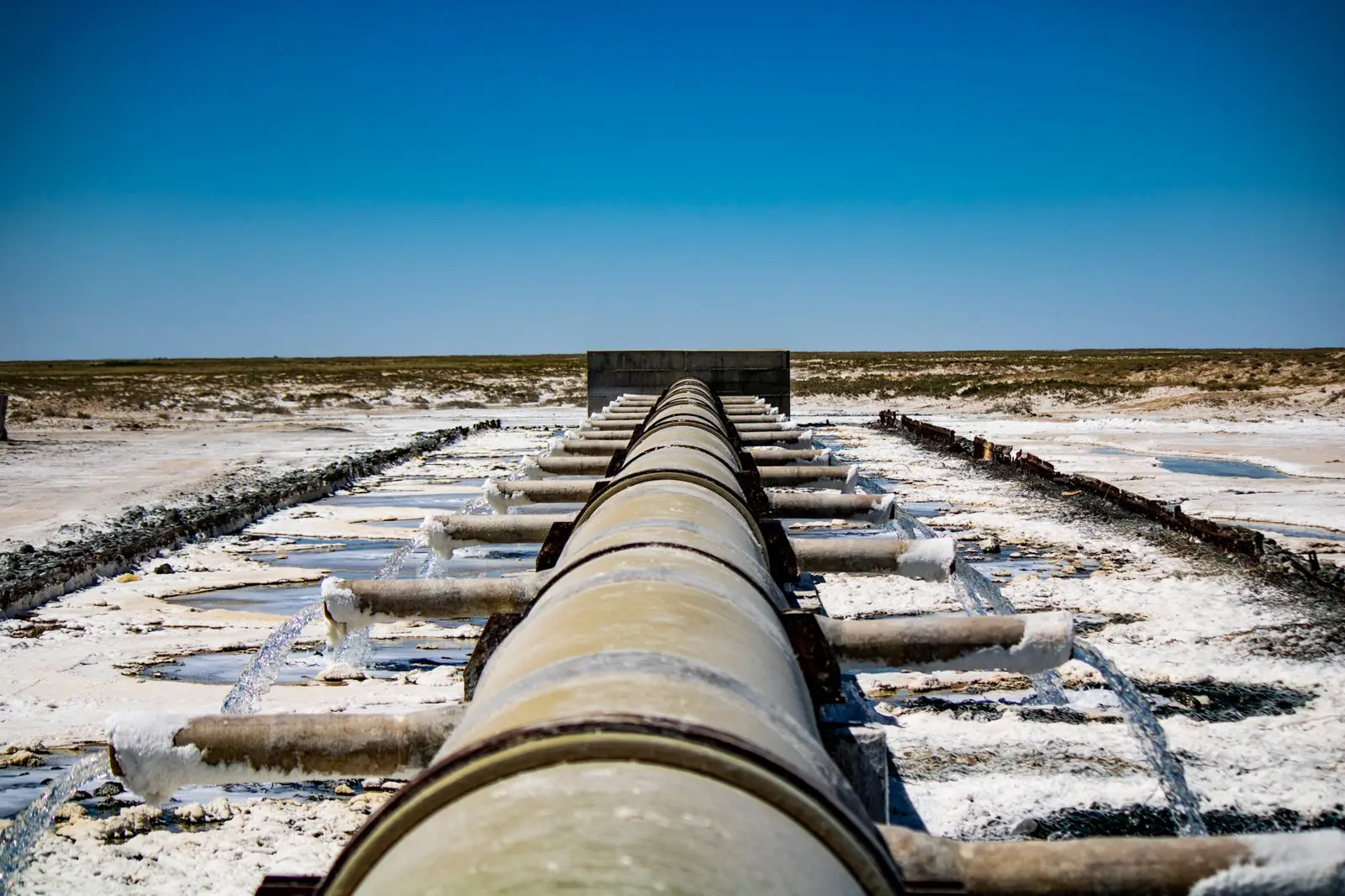
The inland concentrate problem
Brackish groundwater RO plants recover 75–85% of their feed as product water and reject the rest as concentrate at 4–10 times feed salinity. Coastal plants send that to an ocean outfall at $0.05–$0.50/m³. Inland plants usually have no outfall, so concentrate disposal becomes the limiting factor on plant capacity and often its largest operating line after energy.
Brine line tariff mechanics
A few basins have dedicated brine interceptors. The SAWPA Inland Empire Brine Line (formerly SARI) in Southern California charges for purchased capacity units plus volume, strength and treatment components:
| Component | Published level | Notes |
|---|---|---|
| Conveyance (piped) | ~$1,141 /MG (~$0.30/m³) | Plus purchased capacity units |
| Regional treatment pass-through (OC San) | ~$1,754+ /MG | Applied to flow reaching the treatment plant |
| BOD surcharge | $462–$744 /1,000 lb | Strength-based |
| TSS surcharge | $579–$855 /1,000 lb | Strength-based |
| Trucked waste at station | ~$4.52 /m³ ($0.0171/gal) | For haulers discharging at the station |
Even where a brine line exists, capacity is finite and expensive to expand. Every cubic meter not sent down the line frees capacity for growth.
Evaporation pond sizing and liability
Pond area is volume divided by net evaporation (pan evaporation × pan coefficient − rainfall). In a desert climate with ~1.5 m/yr net evaporation, 100 m³/day of concentrate needs roughly 2.5 hectares of water surface before freeboard, dikes and redundancy. Double HDPE liners with leak detection, bird deterrence and eventual closure push all-in pond cost to $2–$10+/m³, and the salt stays on your balance sheet. Cutting the volume by 90% before the pond changes the answer completely.
High-recovery membrane trains
The usual inland solution is to push recovery above 95% with membranes before any thermal step:
- Primary brackish RO at 75–85% recovery.
- Intermediate softening of the RO concentrate (lime/soda, or pellet softening) to remove calcium and silica, the usual limiting scalants.
- Secondary RO or HPRO on the softened concentrate.
- OARO to 100,000–140,000 mg/L if the residual still has no affordable outlet.
- Small MVR, crystallizer or pond for the final few percent.
Silica deserves special attention in groundwater: it often limits primary RO recovery before calcium sulfate does, and is best handled by softening (co-precipitation with magnesium hydroxide) or high-pH operation.
Pre-configured model
Open the modeler with a 150 GPM, 12,000 mg/L high-silica concentrate going to membrane maximum recovery, priced against trucked brine line tipping. Change the endpoint to MVR or ZLD to see what the final percent costs.